 cults3d
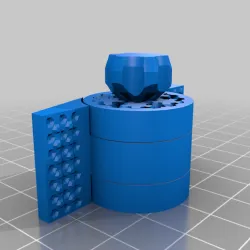
Mini Clamp
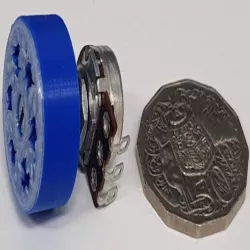
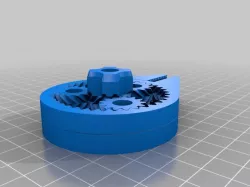
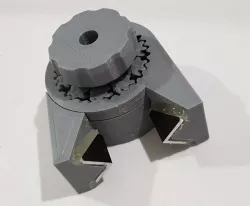
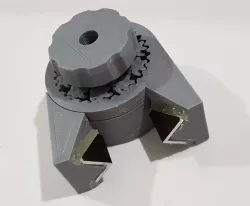
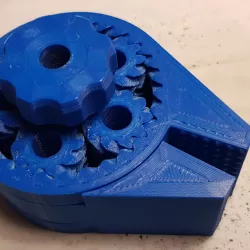
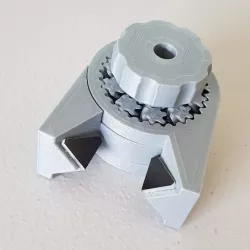
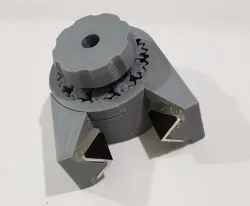
Small clamp with a unique planetary gearbox mechanism for demonstration or recreation.
Prints in place fully assembled without supports.
IMPORTANT: Print at 0.2mm layer height if using the default model, otherwise ensure layer_h parameter matches your layer height if customizing. Check preview before printing and ensure the 1-layer gap is preserved in the outer ring gears.
Use a sharpened spatula, razor or hobby knife to de-laminate the 1-layer gaps (watch fingers and listen for the "crack"), then turn the knob just a little to get the gears moving. Now "crack" the jaws apart manually by back-driving by a few mm (there should be a little backlash). Now all the parts are free, it will be a bit stiff at first but opening and closing a few times will loosen it up. Then apply petroleum jelly or lubricant of choice to gears and work it in (again by opening and closing a few times).
The main improvement of this iteration (aside from a few bug fixes - man, I wish I put this gearbox in github from the beginning) is an internal ridge which acts as a bearing surface. The previous design was very sensitive to gear clearances due to the gears themselves acting as bearings. Too much play in the gears resulted in the jaws going off center and binding. This should allow for more tolerance in the gears and alleviate some of the shear force on the planet gears. I have also incorporated the gear formulas so we don't need the spreadsheets anymore (unless you're hunting for a particular gear ratio).
Direct link to the original creator's page
Also Available On
More from tmackay

Similar Models
Model Specifications
Frequently Asked Questions
How do I download Mini Clamp?
Click the "View on cults3d" button above to visit the original model page on cults3d. You can download the STL file directly from the creator's page.
What 3D printer can I use for this model?
This STL file is compatible with most FDM 3D printers (Creality Ender 3, Prusa MK3S+, Bambu Lab, etc.) and resin printers (Elegoo, Anycubic). Check the original page for recommended print settings and materials.
Is this 3D model free to download?
This is a premium model priced at on cults3d. Premium models often include higher detail, multiple parts, and print-tested files.
Can I modify this STL file?
Most STL files can be modified using free software like Blender, TinkerCAD, or Meshmixer. Check the license on the original cults3d page to see if modifications are permitted by the creator.