 thingiverse
Telescope
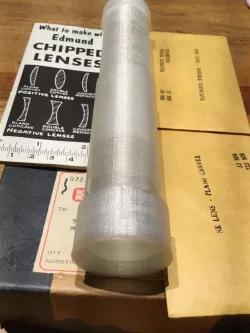
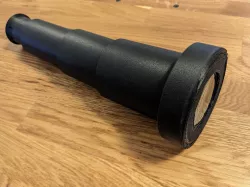
Using the telescope.scad file, the maker can print the parts for a telescope, order the lenses from Edmund Optics, and then assemble it to obtain a working telescope. The maker edits the telescope.scad file to enter the characteristics of the optics such as objective (front) lens diameter, focal length, and thickness and the eyepiece lens diameter focal length and thickness. The OpenSCAD program can then be used to generate the stl files for the telescope using those dimensions.
To make sure that all parts are consistent, the same program is used to generate the stl files for all of the parts. The maker sets the printphase to each of its values in turn, renders the model and then exports each part to a separate stl file.
The parts are then printed and with the purchased optics can be assembled into a working telescope.
I used a 33x223 PCX (plano convex) lens for the objective and a 17x-50 DCV (double concave) lens for the eyepiece. The lenses are specified by their diameter in millimeters then an "x" and their focal length in millimeters. For a Galilean telescope the eyepiece lens has a negative focal length. The magnification can be calculated from the focal length of the objective divided by the focal length of the eyepiece lens (ignoring the sign). So the above lenses would yield a magnification of about 4x.
From the current Edmund Optics website, the following lenses are a good choice, the 42x290 PCX lens for the objective (catalog number 20-565) and the 12.5x-50 DCV lens for the eyepiece (catalog number 95-474). These lenses are located in the clearance products area of their website.
I would recommend that you order the lenses first and wait to print the parts until you can determine the exact dimensions of the lenses. For the clearance lenses on the Edmund Optics website, the dimensions may be slightly off of the listed values, so measure them when you receive them and then put those dimensions into the OpenSCAD program. The focal lengths are close enough that you should be able to reach focus without having the shorted or lengthen the tubes.
The best thing about OpenSCAD is that the models can be completely parametric, so you are free to choose other lenses to make whatever telescope you want. You can choose the focal length of the objective and eyepiece lenses to get different magnifications. Increasing the diameter of the objective lens will increase the field of view.
The lenses that I have used so far have been simple lenses. Such lenses are not color corrected and there may be some color fringes around the moon and bright stars. If you wish to experiment, you can replace the objective lens with an achromat which should reduce the false color and improve the sharpness, but at a higher cost. There is a 36x325 achromat that could be a good choice, but I haven't tried it yet.
If you wish to experiment further, you can replace the negative focal length eyepiece lens with a positive lens and obtain a Keplerian telescope. Such a telescope will allow more magnification and generally work better than the Galilean telescope, but the image will be inverted.
I printed the parts in natural PLA and found that during the day, a lot of light filtered through the parts and reduced the contrast of the image. If you plan to use the telescope during the day, you might want to print it using a more opaque color filament.
On 3/10/19 I replaced the openscad file with a new one to correct an error and to configure it for the Edmund Optics lenses that I just received.
On 3/17/19 I printed a telescope using the lenses recommended above (42x290 PCX lens for the objective (catalog number 20-565) and the 12.5x-50 DCV lens for the eyepiece (catalog number 95-474)) and it seemed to work well.
Direct link to the original creator's page
Also Available On
More from joep

Similar Models
 myminifactory
 thingiverse
 thingiverse
 thingiverse
 thingiverse
 prusaprinters
 thingiverse
 thingiverse
Model Specifications
Frequently Asked Questions
How do I download Telescope?
Click the "View on thingiverse" button above to visit the original model page on thingiverse. You can download the STL file directly from the creator's page for free.
What 3D printer can I use for this model?
This STL file is compatible with most FDM 3D printers (Creality Ender 3, Prusa MK3S+, Bambu Lab, etc.) and resin printers (Elegoo, Anycubic). Check the original page for recommended print settings and materials.
Is this 3D model free to download?
Yes, this model is available as a free download on thingiverse. Some creators accept tips or donations.
Can I modify this STL file?
Most STL files can be modified using free software like Blender, TinkerCAD, or Meshmixer. Check the license on the original thingiverse page to see if modifications are permitted by the creator.