 cults3d
Spool Bot
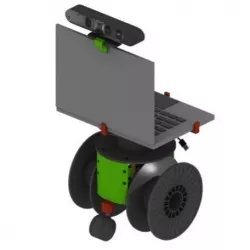
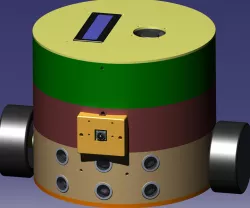
Spool Bot is a wheeled robot capabile of navigating complex indoor environments. It is made with empty 3d printer filament spools, caster wheels from an old office chair, and some custom parts made on a 3D printer. It senses the environment using a depth camera and moves around using 2 standard servos. The brains are provided by an Arduino microcontroller and a laptop. The power for the robot comes solely from the laptop eliminating the need for external batteries.
One of my first robots was the ER1 that used a laptop to do some simple computer vision via a web cam and rolled around on rollerblade wheels. It was a well designed machine and for its time was very advanced. There are some more contemporary robot platforms that use depth camera instead of web cams to be able to do more advanced computer vision. One such robot is the Eddie Platform from Parallax, but with price tags upwards of $1200 without the laptop or depth camera is didn’t sound very appealing to me.
That’s where Spool bot comes in. It was created to be a simple, low cost way to try out sensor and computing platforms for future bipedal robot prototypes from Project Biped (www.projectbiped.com). At about $250 including the depth camera (excluding the laptop) it allows for some computer vision fun without breaking the bank. It has the advantage of being able to heft heavy computers without having to balance on spindly legs. Once Spoolbot has helped identify a suitable combination of sensors then the job of shrinking and lightening the computer will be undertaken.
Direct link to the original creator's page
Also Available On
More from enzordplst

Similar Models


Model Specifications
Frequently Asked Questions
How do I download Spool Bot?
Click the "View on cults3d" button above to visit the original model page on cults3d. You can download the STL file directly from the creator's page.
What 3D printer can I use for this model?
This STL file is compatible with most FDM 3D printers (Creality Ender 3, Prusa MK3S+, Bambu Lab, etc.) and resin printers (Elegoo, Anycubic). Check the original page for recommended print settings and materials.
Is this 3D model free to download?
This is a premium model priced at on cults3d. Premium models often include higher detail, multiple parts, and print-tested files.
Can I modify this STL file?
Most STL files can be modified using free software like Blender, TinkerCAD, or Meshmixer. Check the license on the original cults3d page to see if modifications are permitted by the creator.