 cgtrader
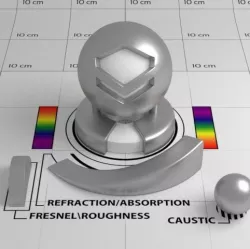
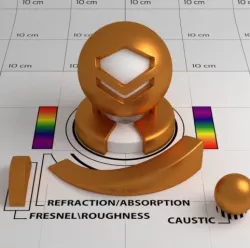
Silver Shader Texture
Silver is a chemical element with the symbol Ag (from the Latin argentum, derived from the Proto-Indo-European hâerǵ: shiny or white) and atomic number 47. A soft, white, lustrous transition metal, it exhibits the highest electrical conductivity, thermal conductivity, and reflectivity of any metal. The metal is found in the Earth's crust in the pure, free elemental form (native silver), as an alloy with gold and other metals, and in minerals such as argentite and chlorargyrite. Most silver is produced as a byproduct of copper, gold, lead, and zinc refining.
Silver has long been valued as a precious metal. Silver metal is used in many bullion coins, sometimes alongside gold: while it is more abundant than gold, it is much less abundant as a native metal. Its purity is typically measured on a per-mille basis; a 94%-pure alloy is described as 0.940 fine. As one of the seven metals of antiquity, silver has had an enduring role in most human cultures.
Other than in currency and as an investment medium (coins and bullion), silver is used in solar panels, water filtration, jewellery, ornaments, high-value tableware and utensils (hence the term silverware), in electrical contacts and conductors, in specialized mirrors, window coatings, in catalysis of chemical reactions, as a colorant in stained glass and in specialised confectionery. Its compounds are used in photographic and X-ray film. Dilute solutions of silver nitrate and other silver compounds are used as disinfectants and microbiocides (oligodynamic effect), added to bandages and wound-dressings, catheters, and other medical instruments.
Silver and gold have rather low chemical affinities for oxygen, lower than copper, and it is therefore expected that silver oxides are thermally quite unstable. Soluble silver(I) salts precipitate dark-brown silver(I) oxide, Ag2O, upon the addition of alkali. (The hydroxide AgOH exists only in solution; otherwise it spontaneously decomposes to the oxide.) Silver(I) oxide is very easily reduced to metallic silver, and decomposes to silver and oxygen above 160 °C. This and other silver(I) compounds may be oxidized by the strong oxidizing agent peroxodisulfate to black AgO, a mixed silver(I,III) oxide of formula AgIAgIIIO2. Some other mixed oxides with silver in non-integral oxidation states, namely Ag2O3 and Ag3O4, are also known, as is Ag3O which behaves as a metallic conductor.
Silver(I) sulfide, Ag2S, is very readily formed from its constituent elements and is the cause of the black tarnish on some old silver objects. It may also be formed from the reaction of hydrogen sulfide with silver metal or aqueous Ag+ions. Many non-stoichiometric selenides and tellurides are known; in particular, AgTe~3 is a low-temperature superconductor.
Silver forms alloys with most other elements on the periodic table. The elements from groups 1â3, except for hydrogen, lithium, and beryllium, are very miscible with silver in the condensed phase and form intermetallic compounds; those from groups 4â9 are only poorly miscible; the elements in groups 10â14 (except boron and carbon) have very complex AgâM phase diagrams and form the most commercially important alloys; and the remaining elements on the periodic table have no consistency in their AgâM phase diagrams. By far the most important such alloys are those with copper: most silver used for coinage and jewellery is in reality a silverâcopper alloy, and the eutectic mixture is used in vacuum brazing. The two metals are completely miscible as liquids but not as solids; their importance in industry comes from the fact that their properties tend to be suitable over a wide range of variation in silver and copper concentration, although most useful alloys tend to be richer in silver than the eutectic mixture (71.9% silver and 28.1% copper by weight, and 60.1% silver and 28.1% copper by atom).
Most other binary alloys are of little use: for example, silverâgold alloys are too soft and silverâcadmium alloys too toxic. Ternary alloys have much greater importance: dental amalgams are usually silverâtinâmercury alloys, silverâcopperâgold alloys are very important in jewellery (usually on the gold-rich side) and have a vast range of hardnesses and colours, silverâcopperâzinc alloys are useful as low-melting brazing alloys, and silverâcadmiumâindium (involving three adjacent elements on the periodic table) is useful in nuclear reactors because of its high thermal neutron capture cross-section, good conduction of heat, mechanical stability, and resistance to corrosion in hot water.
The word silver appears in Anglo-Saxon in various spellings, such as seolfor and siolfor. A similar form is seen throughout the Germanic languages (compare Old High German silabar and silbir). The chemical symbol Ag is from the Latin word for silver, argentum (compare Ancient Greek á¼ÏγÏ
ÏοÏ, árgyros), from the Proto-Indo-European root *hâerǵ- (formerly reconstructed as *arǵ-), meaning white or shining: this was the usual Proto-Indo-European word for the metal, whose reflexes are missing in Germanic and Balto-Slavic. The Balto-Slavic words for silver are quite similar to the Germanic ones (e.g. Russian ÑеÑебÑо [serebro], Polish srebro, Lithuanian sidabras) and they may have a common origin, although this is uncertain: some scholars have suggested the Akkadian sarpu refined silver as this origin, related to the word sarapu to refine or smelt.
Direct link to the original creator's page
Also Available On
More from 5555nkt



Similar Models

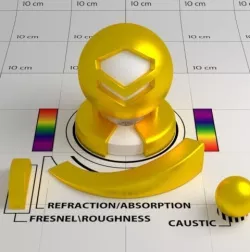

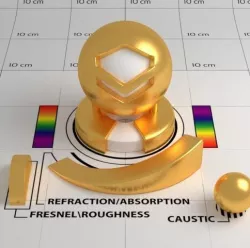

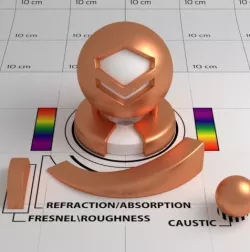
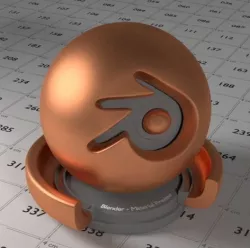
Model Specifications
Frequently Asked Questions
How do I download Silver Shader Texture?
Click the "View on cgtrader" button above to visit the original model page on cgtrader. You can download the STL file directly from the creator's page.
What 3D printer can I use for this model?
This STL file is compatible with most FDM 3D printers (Creality Ender 3, Prusa MK3S+, Bambu Lab, etc.) and resin printers (Elegoo, Anycubic). Check the original page for recommended print settings and materials.
Is this 3D model free to download?
This is a premium model priced at on cgtrader. Premium models often include higher detail, multiple parts, and print-tested files.
Can I modify this STL file?
Most STL files can be modified using free software like Blender, TinkerCAD, or Meshmixer. Check the license on the original cgtrader page to see if modifications are permitted by the creator.