 thingiverse
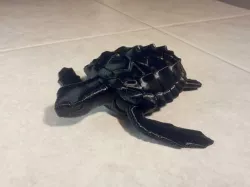
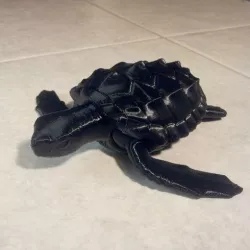
Loggerhead Turtle
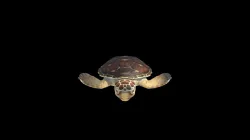
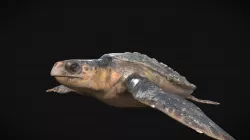
Loggerheads were named for their relatively large heads, which support powerful jaws and enable them to feed on hard-shelled prey, such as whelks and conch. The top shell (carapace) is slightly heart-shaped and reddish-brown in adults and sub-adults, while the bottom shell (plastron) is generally a pale yellowish color. The neck and flippers are usually dull brown to reddish brown on top and medium to pale yellow on the sides and bottom.
In the southeastern U.S., mating occurs in late March to early June and females lay eggs between late April and early September. Females lay three to five nests, and sometimes more, during a single nesting season. The eggs incubate approximately two months before hatching sometime between late June and mid-November.
Hatchlings lack the reddish-brown coloration of adults and juveniles. Their flippers are dark gray to brown above with white to white-gray margins. The coloration of the plastron is generally yellowish to tan.
Habitat
Loggerheads occupy three different ecosystems during their lives:
beaches (terrestrial zone)
water (oceanic zone)
nearshore coastal areas ("neritic" zone)
Loggerheads nest on ocean beaches, generally preferring high energy, relatively narrow, steeply sloped, coarse-grained beaches.
Immediately after hatchlings emerge from the nest, they begin a period of frenzied activity. During this active period, hatchlings move from their nest to the surf, swim, and are swept through the surf zone, and continue swimming away from land for up to several days.
After this swim frenzy period, post-hatchling loggerheads take up residence in areas where surface waters converge to form local downwellings. These areas are often characterized by accumulations of floating material, such as seaweed (for example, Sargassum), and, in the southeast U.S., are common between the Gulf Stream and the southeast U.S. coast, and between the Loop Current and the Gulf Coast of Florida. Post-hatchlings within this habitat are observed to be low-energy float-and-wait foragers that feed on a wide variety of floating items (Witherington 2002). As post-hatchlings, loggerheads may linger for months in waters just off the nesting beach or become transported by ocean currents within the Gulf of Mexico and North Atlantic. Work by Lohmann and Lohmann (1994b, 1996) and Lohmann et al. (1999) suggests that loggerheads may continue some oriented swimming in order to keep from being swept into cold North Atlantic currents. Scientists are also remotely tracking neonate loggerhead sea turtles using small, solar-powered satellite tags.
Once individuals get transported by ocean currents farther offshore, they've entered the oceanic zone. Within the North Atlantic, juvenile loggerheads have been primarily studied in the waters around the Azores and Madeira (Bolten 2003). Other populations exist (for example, in the region of the Grand Banks off Newfoundland), but data on these populations are limited. The juvenile turtles around the Azores and Madeira spend the majority of their time in the top 15 feet (5 m) of the water column.
Somewhere between 7-12 years old, oceanic juveniles migrate to nearshore coastal areas (neritic zone) and continue maturing until adulthood. In addition to providing critically important habitat for juveniles, the neritic zone also provides crucial foraging habitat, inter-nesting habitat, and migratory habitat for adult loggerheads in the western North Atlantic. To a large extent, these habitats overlap with the juvenile stage, the exception being most of the bays, sounds, and estuaries along the Atlantic and Gulf coasts of the U.S. from Massachusetts to Texas, which are infrequently used by adults. However, adult loggerheads are present year-round in Florida Bay, an important feeding area, probably because of relatively easy access to open ocean and migratory routes.
http://www.nmfs.noaa.gov/pr/species/turtles/loggerhead.htm
Direct link to the original creator's page
Also Available On
More from lcds



Similar Models
 sketchfab
 thingiverse
 sketchfab
 thingiverse
 cults3d
 grabcad
 cgtrader
 myminifactory
Model Specifications
Frequently Asked Questions
How do I download Loggerhead Turtle?
Click the "View on thingiverse" button above to visit the original model page on thingiverse. You can download the STL file directly from the creator's page for free.
What 3D printer can I use for this model?
This STL file is compatible with most FDM 3D printers (Creality Ender 3, Prusa MK3S+, Bambu Lab, etc.) and resin printers (Elegoo, Anycubic). Check the original page for recommended print settings and materials.
Is this 3D model free to download?
Yes, this model is available as a free download on thingiverse. Some creators accept tips or donations.
Can I modify this STL file?
Most STL files can be modified using free software like Blender, TinkerCAD, or Meshmixer. Check the license on the original thingiverse page to see if modifications are permitted by the creator.