 thingiverse
Julia Set
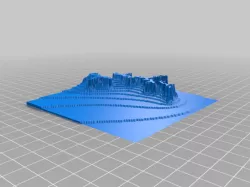
The Julia Set is commonly associated with the iterative function z_n+1 = z_n + c where c is a constant complex value. This set is name after the French mathematician Gaston Julia who published his famous paper on the subject in 1918. Each Julia Set can be found in the Mandelbrot Set. These can be either connected or disconnected from the main structure of the Mandelbrot Set. Points disconnected from the set appear as small points and are sometimes referred to as "dust".
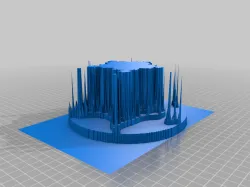
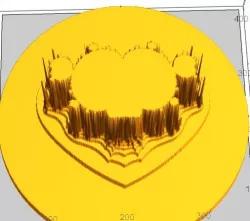
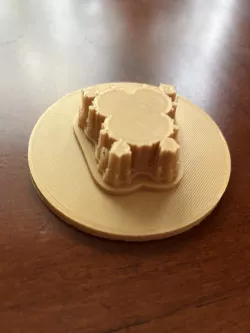
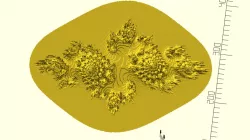
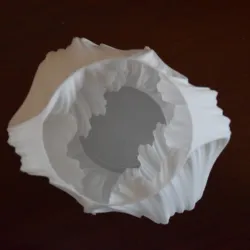
By choosing different values of c, one can select various Julia Sets from the overarching Mandelbrot Set. In this case, I chose the value c = -0.052 + 0.952i. I used the JuliaSetPoints command in Mathematica to find this constant. After that, it was as simple matter of plotting the set using JuliaSetIterationCount and ListPlot3D.
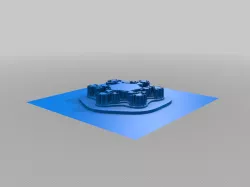
Exporting the object was a bit of a challenge. When using the ListPlot3D, Mathematica will include points far outside the specified plot range. This is easy to miss until you end up with a 25 mb stl file that's two feet wide and a millimeter thick. To avoid this, I needed to specify the desired range and a function within ListPlot3D. After that, the file was a much more reasonable 3 mb.
Bourke, Paul. “Julia Set Fractal (2D).” Julia Set Fractal, http://paulbourke.net/fractals/juliaset/.
Direct link to the original creator's page
Also Available On
More from haskillg
Similar Models
Model Specifications
Frequently Asked Questions
How do I download Julia Set?
Click the "View on thingiverse" button above to visit the original model page on thingiverse. You can download the STL file directly from the creator's page for free.
What 3D printer can I use for this model?
This STL file is compatible with most FDM 3D printers (Creality Ender 3, Prusa MK3S+, Bambu Lab, etc.) and resin printers (Elegoo, Anycubic). Check the original page for recommended print settings and materials.
Is this 3D model free to download?
Yes, this model is available as a free download on thingiverse. Some creators accept tips or donations.
Can I modify this STL file?
Most STL files can be modified using free software like Blender, TinkerCAD, or Meshmixer. Check the license on the original thingiverse page to see if modifications are permitted by the creator.