 Cults3D
07. Great Hexagonal Hexecontahedron – 18. Self-Intersecting Snub Quasi-Regular Duals Earrings & Necklace - Geometric Earring - Sacred Geometry Necklace Fashion Statement
Title: 18. Self-Intersecting Snub Quasi-Regular Duals Earrings & Necklace - Geometric Earring - Sacred Geometry Necklace Fashion Statement
Family: 18. Self-Intersecting Snub Quasi-Regular Duals
Motif: Geometry Polyhedra
Model Size: 1 in
Series: Geometry
Family List:
01. Medial Pentagonal Hexecontahedron
03. Great Pentagonal Hexecontahedron
04. Great Inverted Pentagonal Hexecontahedron
06. Medial Hexagonal Hexecontahedron
07. Great Hexagonal Hexecontahedron
08. Small Hexagonal Hexecontahedron
Self-Intersecting Snub Quasi-Regular Duals: Exotic Isohedral Pentagonal Hexecontahedra of Chiral Stars
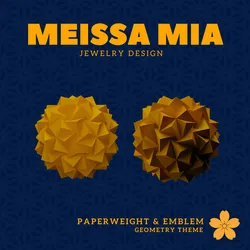
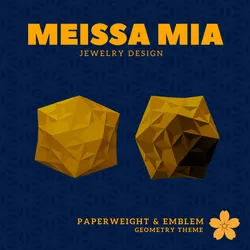
Self-intersecting snub quasi-regular duals are a mesmerizing group of nonconvex isohedral polyhedra that arise as the duals of the chiral self-intersecting snub quasi-regular uniform stars, featuring 60 irregular or mirror-symmetric pentagonal faces that deeply penetrate one another, forming dense, self-crossing structures with high topological complexity. These face-transitive solids include the great pentagonal hexecontahedron (dual to the great snub icosidodecahedron), great inverted pentagonal hexecontahedron (dual to the great inverted snub icosidodecahedron), medial inverted pentagonal hexecontahedron, and others like the medial hexagonal hexecontahedron for related snubs. Portions of their concave pentagonal faces lie inside the core, creating hidden intersections and cavities visible only in transparent or wireframe renders, while preserving the underlying icosahedral symmetry.
Constructed via polar reciprocation of their vertex-transitive chiral counterparts, these duals showcase scalene or asymmetric pentagons with varying edge lengths, resulting in dihedral angles that evoke swirling, petal-like layers. In 3D visualization tools such as Stella4D, their self-penetrating facets produce stunning depth effects, with chiral pairs mirroring the handedness of the original snubs, bridging convex Catalan solids to extreme nonconvex forms.
For 3D printing cults, these hexecontahedra are ultimate treasures—challenging to print due to intersections but breathtaking in translucent resin that reveals internal glows, or as large-scale metallic sculptures capturing chiral twists. Makers produce enantiomorphic pairs for display, embed lighting for ethereal effects, or compound them for infinite-depth illusions, making them icons of advanced geometric artistry and topological wonder.
Originator of the Geometry
The self-intersecting snub quasi-regular duals, primarily the various pentagonal and hexagonal hexecontahedra, were identified as duals to the nonconvex uniform snub star polyhedra during the mid-20th-century enumeration of the 75 uniform polyhedra by H.S.M. Coxeter, M.S. Longuet-Higgins, and J.C.P. Miller in their 1954 paper, with completeness proven by John Skilling in 1975. Specific nonconvex isohedral forms, including the great pentagonal hexecontahedron and its variants, are extensively documented, named, and visualized in modern catalogs by David McCooey and others, extending the convex pentagonal hexecontahedron (dual to the snub dodecahedron) into the self-intersecting star domain.
Direct link to the original creator's page
Similar Models
 Cults3D
 Cults3D
 Cults3D
 Cults3D
 Cults3D
 Cults3D
 Cults3D
 Cults3D
Model Specifications
Frequently Asked Questions
How do I download 07. Great Hexagonal Hexecontahedron – 18. Self-...?
Click the "View on Cults3D" button above to visit the original model page on Cults3D. You can download the STL file directly from the creator's page.
What 3D printer can I use for this model?
This model is compatible with most FDM 3D printers (Creality Ender 3, Prusa MK3S+, Bambu Lab, etc.) and resin printers (Elegoo, Anycubic). Check the original page for recommended print settings and materials.
Is this 3D model free to download?
This is a premium model priced at 1.25 EUR on Cults3D. Premium models often include higher detail, multiple parts, and print-tested files.
Can I modify this file?
Check the license (see original page) on the original Cults3D page. Most STL files can be modified using free software like Blender, TinkerCAD, or Meshmixer.